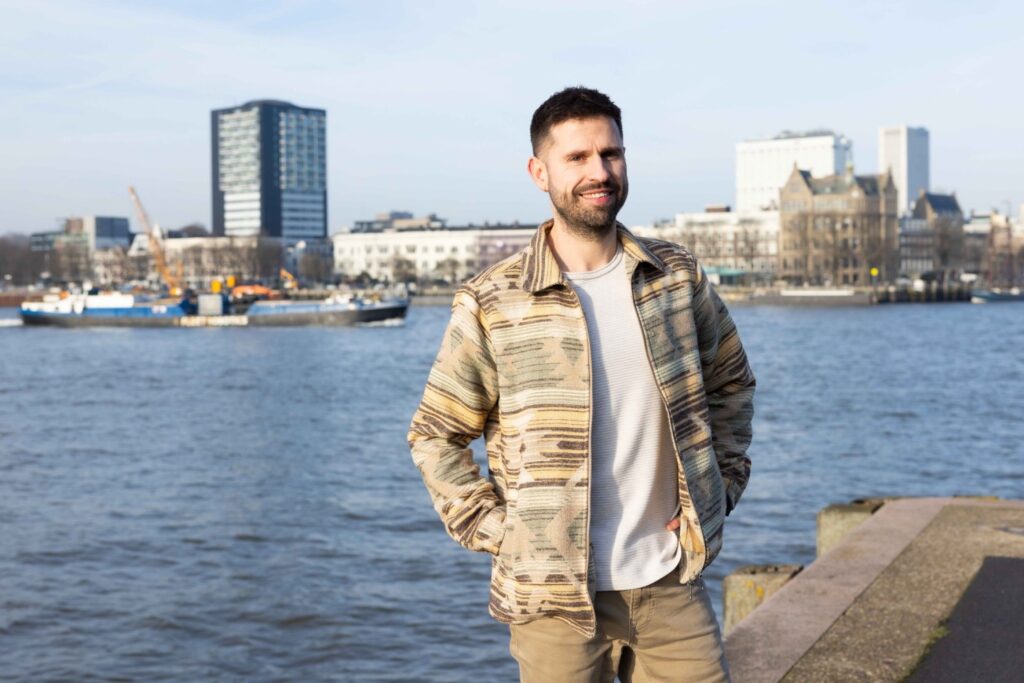
Yannick Duijster’s connection to Rotterdam is more than professional. He lives there, bikes to work and enjoys contributing to the city that surrounds him. Having begun in civil engineering, Yannick gradually shifted into BIM because he saw potential in digital modelling. Over time, that shift took him from working as a draughtsman and modeller to coordinating BIM on the owner’s side at Europe’s largest port: Port of Rotterdam. His role today is not tied to one landmark construction, but to the long-term integrity of many assets across the harbour.
From delivery to continuity
One of Yannick’s key tasks is helping the organisation understand why BIM matters beyond design visualisation. The hardest part, he acknowledges, is that the benefits arrive later.
“Many of the advantages do not show themselves until the asset needs maintenance. That is when data quality becomes essential.”
Inside the organisation, some colleagues immediately grasp this, while others are still adjusting to structured naming conventions and metadata requirements. Externally, it becomes even more complex. Contractors and engineers work with different tools, habits and maturities. The port uses an internal Object Type Library to specify required data for every asset type, but delivery varies.
“We know what data we want. The challenge is getting everyone to deliver it in the same structured way.”
Every year, more than 60 new projects are initiated at the port, ranging from small modifications to major quay reconstructions. Each of them produces asset information. Over time, that data becomes the operational memory of the infrastructure. Yannick views BIM not as a static model, but as a progressive history of decisions.
Building a foundation for the future
When the conversation turns to legacy infrastructure, Yannick is careful to be precise. Much of the harbour was built decades ago, long before BIM existed, and many assets are still documented only through 2D drawings and archived records.
“Some of our assets are more than fifty years old and only exist as paper drawings in a basement.”
While digitising these assets is not yet part of his team’s day-to-day work, it is clearly on the horizon. The current focus is on implementing BIM properly for running and future projects. Yannick is convinced that concentrating only on new assets will not be sufficient in the long term. Once BIM processes, data requirements and validation workflows are fully embedded for new projects, the organisation will need to address how existing assets can be brought into the same digital logic.
That same long-term thinking applies to how BIM is used internally. Today, BIM expertise largely sits with specialists, and access to insights from models is still mediated. Yannick expects this to change.
“Non-BIM specialists should be able to access their information independently.”
BIM should become a shared resource, not a gated one.

A shift in the industry mindset
Yannick firmly rejects the idea that BIM is reaching its end. If anything, he believes it is evolving into something larger.
“It used to be a design tool. Now it is becoming an organisational foundation.”
For him, data-driven infrastructure is not optional. Clients are increasingly demanding structured asset data, and organisations that fail to deliver it will eventually lose relevance. Yannick sees this transition happening not just at the port, but across the sector. Specialists who once worked in 2D drawings are now thinking in networked 3D information systems.
He also points out that sustainability has become a central KPI inside Port of Rotterdam.
“We are not in a race to build faster. We want to build smarter and more sustainably.”
BIM is not used to accelerate blindly, but to make less wasteful decisions and prolong the life of existing infrastructure.

The harbour as a living dataset
When asked what change would have the biggest impact, Yannick does not mention AI or robotics. His answer is concise: uniform data discipline.
If every contractor encoded data consistently from the start, the port’s validation workflows would be dramatically simplified.
“If we could just snap our fingers and have everyone up to speed, that would be a very big win.”
Yannick’s perspective is quietly visionary. He does not frame BIM as a glamorous interface or a 3D gimmick, but as a mechanism for retaining intelligence over time. The infrastructure of the port is constantly reconstructed, repurposed and reinforced. With each cycle, the model accumulates detail and history.
In the end, his role is not just coordinating models, but stewarding operational memory. He is helping to ensure that 20 or 30 years from now, someone can inspect a quay wall, click on its record and instantly understand its lineage.
“BIM is not fading away. It is expanding.”
This article originally appeared in ONSIGHT Magazine Issue #01 2026, the magazine for digital transformation in the construction industry, published by Vitus. Download the full magazine for free. More from ONSIGHT: Some Bridges You Have to Build Twice and Data Doesn’t Care About Your Gut Feeling.