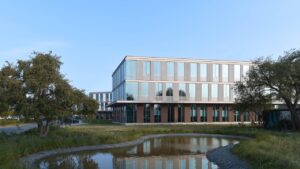
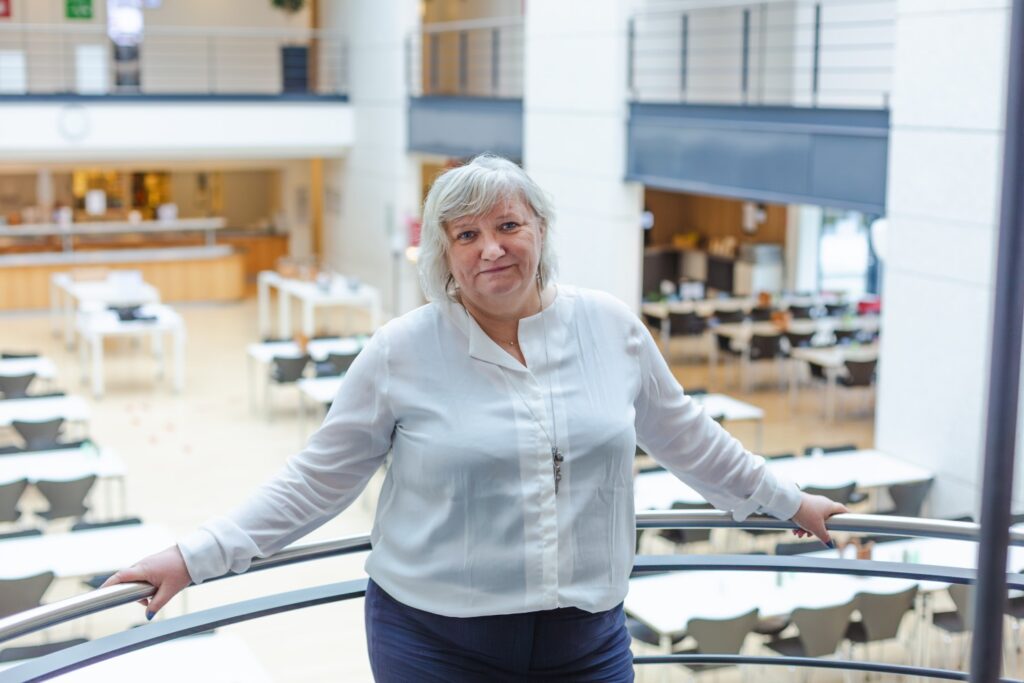
Jette Bakgaard Stolberg is Expertise Director for BIM and ICT at NIRAS, where she helps set the digital direction for one of Denmark’s largest engineering consultancies. Her definition of the role is disarmingly human: deciding what to develop, what to buy, and how to help people do their work better.
Listening first
When Jette Bakgaard Stolberg describes her job, she does not start with platforms or processes. She starts with ears.
“The job requires enormous ears. I have to listen to what my colleagues experience on projects. They’re the ones dealing with the real problems.”
Passing the “Erik” test
Jette keeps returning to one story. Erik was a senior ventilation engineer, well into his late sixties, who had spent a career reading flat drawings and paper diagrams. When the team introduced 3D modelling, he was sceptical. Then something shifted. Erik saw the value in the new way of working and began flying through the models, racing along virtual ductwork to spot clashes before anyone else. The team called it “the Erik test.”
“It wasn’t the technology that mattered. It was watching someone who had every reason to resist find genuine value in a new way of working. That’s what I get up for in the morning.”
The story also carries a warning. When Jette was still in the software industry and Revit first arrived, she was certain the entire profession would be modelling within five years.
“That didn’t happen. Individual adoption can surprise you. Erik proved that. But industry-wide change is always slower than you expect. You have to say it and show it many, many times, because they’ve been building houses for a hundred years.”
The beer crate method
NIRAS employs thousands of engineers with deep specialist knowledge. Jette describes them, with affection, as people who value autonomy.
“It’s in the DNA. They have their way of doing things, and that independence is part of what makes them excellent. But it can make standardisation a long conversation.”
The challenge is familiar across the industry. Adoption rarely fails because the technology is inadequate. It fails because people need to see it work for someone like them. Jette’s strategy is built around that principle: rather than standing on the soapbox herself, she gets the structural engineer or project manager who has seen results to share the story with peers.
NIRAS has formalised this into a learning model. Short, modular sessions delivered just in time when a colleague needs the skill, and not months before. Internal knowledge sharing sessions where practitioners share real project experiences and challenges. Peer mentoring within the same discipline, because a ventilation engineer learns best from another ventilation engineer.
“We don’t send people on three-day courses. Knowledge leaves that fast.”
Build, buy or share
NIRAS has the scale to develop their own digital tools: custom automations, robotic process scripts, internal applications. But Jette is candid about the cost.
“We spend a lot of money maintaining our in-house tools.”
And there is the vulnerability: what happens when the person who built it leaves? Every time they start something new, the question is whether to build it, find a solution in the market, or find someone who can develop it together.
It is a dilemma that smaller and mid-sized firms face even more acutely. They have the same repetitive work, the same need for automation, but not the internal development muscle.
“They’re on exactly the same journey. They just depend more on vendors stepping in to help.”
This conviction extends to her work outside NIRAS. As chair of Molio’s IKT user group, Jette was part of the working group behind the recent overhaul of Denmark’s drawing standards: new publications for landscape and fire safety, updated standards aligned to current ISO requirements, and a new digital app mapping drawing deliverables across project phases.
“The app makes it easier to talk across disciplines and understand what each party delivers at each stage. That kind of shared foundation lifts the whole industry, not just the big players.”
The data reckoning
Jette started in the software industry implementing early CAD and BIM tools. When she moved to the advisory side nearly twenty years ago, digital models were a novelty. Today, they are the baseline for any serious tender.
“If you don’t have the right references, you can’t even bid. The large clients such as hospitals, defence, or airports won’t let you in the door without proof that you’ve delivered digitally. And those references can’t be eight years old.”
Yet trust in project data remains imperfect. Jette recognises the gap.
“Engineers want to stand behind exactly what the data says. So they check it themselves. But over time, when they verify and the numbers hold, the confidence grows.”
The deeper issue, she believes, is data structure. The industry has been talking about it for a decade, but the urgency is new.
“With AI arriving inside our tools, you realise: if the data underneath isn’t clean, none of it works. That’s why every leader I talk to now has data structure at the top of their agenda.”
The distance still to travel, she believes, is not primarily technical. It is cultural: convincing autonomous specialists that structure and freedom can coexist.
“Our colleagues are our gold. We can have all the IT systems in the world, but if we don’t bring our people along, we won’t get anywhere.”
This article originally appeared in ONSIGHT Magazine Issue #01 2026, the magazine for digital transformation in the construction industry, published by Vitus. Download the full magazine for free. More from ONSIGHT: Architecture Must Rediscover Its Purpose and Data Doesn’t Care About Your Gut Feeling.